Justicia Ciega oye tu corazón
Dataset
https://www.kaggle.com/datasets/kinguistics/heartbeat-sounds?utm_source=chatgpt.com
Con este código:
# ============================================================
# CARDIO IA - JUSTICIA CIEGA
# IA PARA DETECTAR LATIDOS CARDÍACOS
# KAGGLE NOTEBOOK SIMPLE Y FUNCIONAL
# ============================================================

# ============================================================
# 1. IMPORTAR LIBRERÍAS
# ============================================================

import os
import numpy as np
import matplotlib.pyplot as plt

import librosa
import librosa.display

from sklearn.model_selection import train_test_split
from sklearn.preprocessing import LabelEncoder

import tensorflow as tf

from tensorflow.keras.models import Sequential

from tensorflow.keras.layers import (
    Dense,
    Dropout
)

# ============================================================
# 2. RUTA DEL DATASET
# ============================================================

DATASET_PATH = "/kaggle/input/datasets/kinguistics/heartbeat-sounds"

# ============================================================
# 3. COMPROBAR ESTRUCTURA DEL DATASET
# ============================================================

print("===================================")
print("ESTRUCTURA DEL DATASET")
print("===================================\n")

for dirname, _, filenames in os.walk(DATASET_PATH):

    print(dirname)

    for filename in filenames[:3]:

        print("   ", filename)

# ============================================================
# 4. DEFINIR RUTAS
# ============================================================

NORMAL_PATH = os.path.join(
    DATASET_PATH,
    "set_a"
)

ABNORMAL_PATH = os.path.join(
    DATASET_PATH,
    "set_b"
)

print("\n===================================")
print("RUTAS")
print("===================================\n")

print("SET_A:")
print(NORMAL_PATH)

print("\nSET_B:")
print(ABNORMAL_PATH)

# ============================================================
# 5. FUNCIÓN PARA EXTRAER CARACTERÍSTICAS
# ============================================================

def extract_features(file_path):

    try:

        # CARGAR AUDIO
        audio, sample_rate = librosa.load(
            file_path,
            sr=None
        )

        # EXTRAER MFCC
        mfccs = librosa.feature.mfcc(
            y=audio,
            sr=sample_rate,
            n_mfcc=40
        )

        # MEDIA DE LAS CARACTERÍSTICAS
        mfccs_processed = np.mean(
            mfccs.T,
            axis=0
        )

        return mfccs_processed

    except Exception as e:

        print("\nERROR EN:")
        print(file_path)

        print(e)

        return None

# ============================================================
# 6. CREAR LISTAS
# ============================================================

features = []

labels = []

# ============================================================
# 7. CARGAR SET_A = SANO
# ============================================================

print("\n===================================")
print("CARGANDO SET_A")
print("===================================\n")

for file in os.listdir(NORMAL_PATH):

    if file.endswith(".wav"):

        file_path = os.path.join(
            NORMAL_PATH,
            file
        )

        data = extract_features(file_path)

        if data is not None:

            features.append(data)

            labels.append("sano")

print("SET_A cargado.")

# ============================================================
# 8. CARGAR SET_B = NO SANO
# ============================================================

print("\n===================================")
print("CARGANDO SET_B")
print("===================================\n")

for file in os.listdir(ABNORMAL_PATH):

    if file.endswith(".wav"):

        file_path = os.path.join(
            ABNORMAL_PATH,
            file
        )

        data = extract_features(file_path)

        if data is not None:

            features.append(data)

            labels.append("no_sano")

print("SET_B cargado.")

# ============================================================
# 9. RESUMEN
# ============================================================

print("\n===================================")
print("RESUMEN")
print("===================================\n")

print("Audios cargados:")

print(len(features))

print("\nEtiquetas:")

print(set(labels))

# ============================================================
# 10. PREPARAR DATOS
# ============================================================

X = np.array(features)

encoder = LabelEncoder()

y = encoder.fit_transform(labels)

# ============================================================
# 11. DIVIDIR TRAIN Y TEST
# ============================================================

X_train, X_test, y_train, y_test = train_test_split(
    X,
    y,
    test_size=0.2,
    random_state=42
)

print("\n===================================")
print("DATOS")
print("===================================\n")

print("Train:", X_train.shape)

print("Test:", X_test.shape)

# ============================================================
# 12. CREAR RED NEURONAL
# ============================================================

model = Sequential()

# CAPA 1
model.add(Dense(
    256,
    input_shape=(40,),
    activation='relu'
))

model.add(Dropout(0.3))

# CAPA 2
model.add(Dense(
    128,
    activation='relu'
))

model.add(Dropout(0.3))

# CAPA 3
model.add(Dense(
    64,
    activation='relu'
))

# SALIDA
model.add(Dense(
    1,
    activation='sigmoid'
))

# ============================================================
# 13. COMPILAR MODELO
# ============================================================

model.compile(
    loss='binary_crossentropy',
    optimizer='adam',
    metrics=['accuracy']
)

print("\n===================================")
print("MODELO COMPILADO")
print("===================================\n")

# ============================================================
# 14. ENTRENAR IA
# ============================================================

history = model.fit(
    X_train,
    y_train,
    epochs=30,
    batch_size=32,
    validation_data=(X_test, y_test)
)

# ============================================================
# 15. EVALUAR IA
# ============================================================

loss, accuracy = model.evaluate(
    X_test,
    y_test
)

print("\n===================================")
print("PRECISIÓN FINAL")
print("===================================\n")

print(accuracy)

# ============================================================
# 16. GRÁFICA DE APRENDIZAJE
# ============================================================

plt.figure(figsize=(10,5))

plt.plot(history.history['accuracy'])

plt.plot(history.history['val_accuracy'])

plt.title("Aprendizaje de Justicia Ciega")

plt.ylabel("Precisión")

plt.xlabel("Épocas")

plt.legend([
    "Entrenamiento",
    "Validación"
])

plt.show()

# ============================================================
# 17. FUNCIÓN PARA PREDECIR
# ============================================================

def predict_heart(audio_file):

    feature = extract_features(audio_file)

    if feature is None:

        print("No se pudo analizar el audio.")

        return

    feature = feature.reshape(1, -1)

    prediction = model.predict(feature)[0][0]

    print("\n===================================")
    print("ANÁLISIS DE JUSTICIA CIEGA")
    print("===================================\n")

    if prediction > 0.5:

        print("⚠️ POSIBLE CORAZÓN ALTERADO")

    else:

        print("❤️ CORAZÓN SANO")

# ============================================================
# 18. EJEMPLO DE USO
# ============================================================

# DESCOMENTA Y CAMBIA EL ARCHIVO PARA PROBAR

# predict_heart("/kaggle/input/datasets/kinguistics/heartbeat-sounds/set_a/normal__201101051104.wav")
da algunos errores pero entrena el modelo:
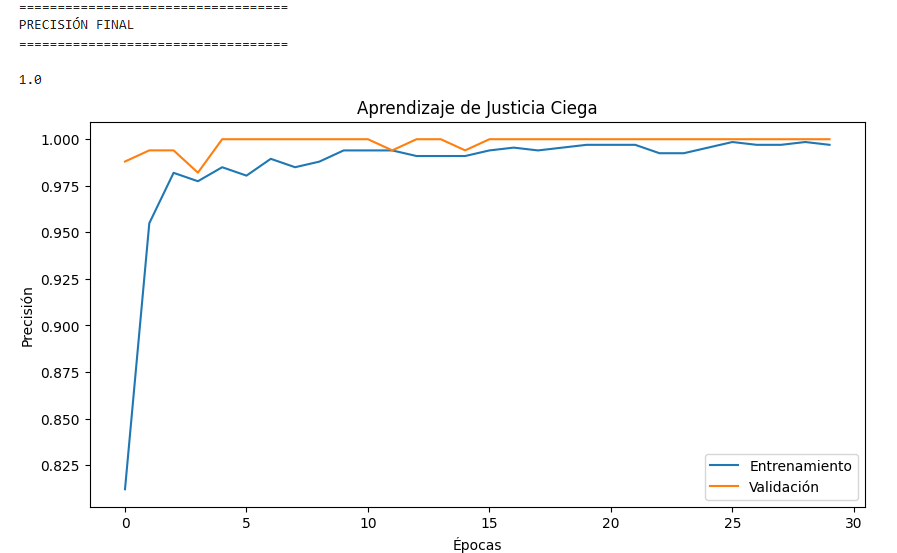
Ahora vamos a probarlo con un archivo real según nos indica al final del código:
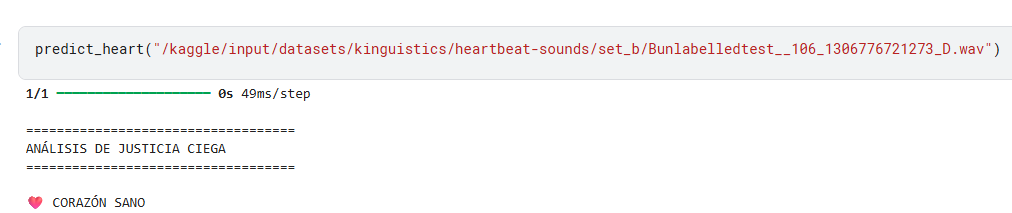
Y creo que lo he hecho al revés porque los del conjunto A son sanos y los del B alterados pero… el sistema funciona.